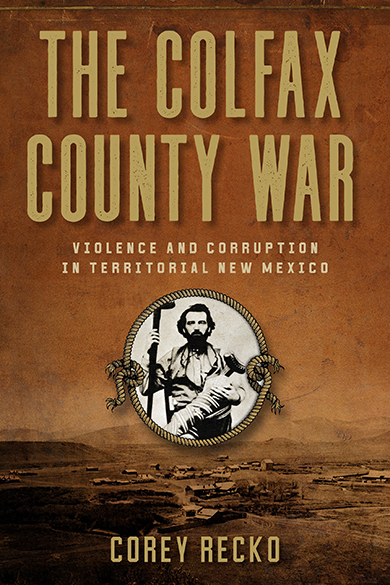
Blood on the Land: The Savage Saga of New Mexico’s Colfax County War
In the rugged, sun-baked landscape of late 19th-century New Mexico, where the promise of the American West clashed violently with the deeply entrenched claims of an older world, a brutal conflict known as the Colfax County War unfolded. More than a mere series of skirmishes, this was a decade-long saga of greed, land fraud, assassination, and vigilante justice that tore apart communities and left an indelible stain on the territory’s history. It was a war not fought by armies, but by settlers, powerful land barons, hired guns, and desperate men, all vying for control of an immense tract of land whose ownership was shrouded in ambiguity and corruption.
At the heart of the conflagration lay the Maxwell Land Grant, a colossal estate originally bestowed by the Mexican government upon Charles Beaubien and Guadalupe Miranda in 1841. This grant, initially encompassing approximately 1.7 million acres, stretched across what is now northeastern New Mexico and southern Colorado, a veritable empire of mountains, forests, and fertile valleys. By the 1860s, the grant had largely come under the control of Lucien Maxwell, a shrewd businessman and frontiersman who had married Beaubien’s daughter. Maxwell, for all his immense wealth, operated with a relatively laissez-faire attitude towards the settlers who had established homes and farms on portions of his vast domain, often selling small parcels or allowing squatters to remain unmolested.
This uneasy peace, however, was shattered in 1870 when Maxwell, facing financial difficulties, sold the entire grant to a group of British and Dutch investors for a reported sum of $1.35 million. The new owners, forming the Maxwell Land Grant & Railway Company, had a distinctly different vision. They were not frontiersmen but capitalists, intent on maximizing profits from their investment. Their strategy was simple: assert absolute control over every acre, evict all "squatters" who could not prove legal title purchased directly from the company, and monetize the land’s resources through logging, mining, and cattle ranching.
This corporate rigidity collided head-on with the deeply ingrained expectations of hundreds of settlers—Hispanos who had lived on the land for generations, Anglo homesteaders who believed they were claiming public domain, and even some who had purchased parcels directly from Maxwell without clear legal documentation. They saw the company’s demands as an egregious affront, an attempt to steal their homes and livelihoods. "We settled this land, we worked it, we bled on it," was the common refrain, echoing the sentiments of a people who saw themselves as pioneers, not trespassers.
The stage was set for war.
The conflict officially ignited in the early 1870s, as the Maxwell Land Grant Company began to survey its immense holdings and demand rent or immediate purchase from those occupying the land. Many settlers, particularly those of Hispanic descent, had long held their lands under traditional, communal systems, often without formal deeds or surveys. The concept of individual, fee-simple ownership as enforced by Anglo-American law was alien to them, and the company’s claims seemed an act of pure dispossession.
The company, however, was not without powerful allies. It swiftly gained the support of the infamous "Santa Fe Ring," a shadowy cabal of influential lawyers, politicians, and businessmen who dominated New Mexico Territory’s legal and political landscape. Figures like Stephen B. Elkins, a former U.S. Attorney and later a Senator, and Thomas B. Catron, a prominent lawyer, often served as legal counsel for the grant company, using their positions to manipulate land laws and judicial decisions in favor of their wealthy clients. This alliance between corporate power and political corruption fueled the settlers’ outrage, convincing them that the legal system was rigged against them.
As tensions mounted, the resistance organized. Settlers formed "Squatters’ Leagues" and "Self-Protective Associations," vowing to resist eviction by any means necessary. Petitions were sent to Washington D.C., and impassioned pleas were made for federal intervention, but little relief came. The situation was a powder keg, and it found its spark in a charismatic and outspoken Methodist minister, Reverend Franklin J. Tolby.
Tolby, an ardent advocate for the settlers, used his pulpit in Cimarron to denounce the grant company and the Santa Fe Ring, accusing them of fraud and injustice. He became a symbol of resistance, giving voice to the voiceless. His fiery sermons and unwavering stance made him a marked man. On September 14, 1875, Tolby was found dead in a ravine near Cimarron, shot in the back. His murder sent shockwaves through the territory and instantly escalated the conflict from legal wrangling to open warfare.
The killing of Tolby ignited a furious wave of vigilante justice. Accusations flew, largely pointing towards company agents and their hired toughs. The community, already deeply divided, spiraled into a cycle of revenge killings. A man named Cruz Vega was accused of Tolby’s murder and, despite his protestations of innocence, was swiftly lynched by a mob led by the notorious gunslinger and cattleman, Clay Allison.
Allison, a fearsome and unpredictable figure known for his quick temper and even quicker draw, had initially been a supporter of the settlers but later became embroiled in the chaos, his allegiances often shifting with the winds of personal grievance. He was a force of nature, responsible for numerous killings throughout the territory, and his presence added a layer of terrifying lawlessness to the Colfax County War. One contemporary account described him as "a man who killed men like other men swat flies," a testament to his brutal reputation. Allison’s involvement underscored the breakdown of civil authority, as local sheriffs and marshals were often powerless, bought off, or simply too afraid to intervene.

The violence became endemic. Shootings, ambushes, and arsons became commonplace. Homes were burned, cattle rustled, and men were murdered in cold blood on both sides. The town of Cimarron, the epicenter of the conflict, became a haven for desperadoes, where saloons served as meeting places for plotting revenge and gunfights erupted with alarming regularity. The very air was thick with suspicion and fear.
The Maxwell Land Grant Company, determined to assert its control, continued its legal battles. The Supreme Court of the United States, in 1887, ultimately sided with the company in the landmark case of United States v. Maxwell Land Grant Company. The Court upheld the validity of the original grant and, crucially, confirmed the company’s claim to its vast acreage. This decision was a crushing blow to the settlers, effectively legalizing their dispossession. For many, it felt like the final betrayal.
Despite the legal victory, the company still faced resistance. Small pockets of violence and defiance continued for years, but the organized resistance of the settlers was broken. Many were forced to abandon their homes, leaving behind generations of sweat and toil. Some managed to purchase small parcels from the company at exorbitant prices, while others simply moved on, seeking new opportunities in other parts of the West.
The Colfax County War, though less widely known than other Western conflicts like the Lincoln County War or the Johnson County War, remains a crucial chapter in the history of the American West. It vividly illustrates the harsh realities of westward expansion, where the abstract ideals of Manifest Destiny often clashed with the very real lives of ordinary people. It was a war fought over land, but also over definitions of justice, property, and the very meaning of American opportunity.
The legacy of the Colfax County War is a complex tapestry woven with threads of tragedy, injustice, and the enduring human spirit of resistance. It exposed the raw power of corporate interests backed by corrupt political machines, and the desperate measures people would take to protect their homes and their way of life. The blood that stained the Colfax soil in the late 19th century serves as a stark reminder that the "winning of the West" was often a brutal, bloody process, where the lines between right and wrong were blurred, and justice was a luxury few could afford. Today, the quiet beauty of Colfax County belies its tumultuous past, but the echoes of the Maxwell Land Grant and the fierce struggle it ignited remain a vital, if often forgotten, part of America’s story.


