
Echoes of Resilience: The Enduring Spirit of Native American Tribes in South Dakota
South Dakota, a land of sprawling prairies, ancient badlands, and sacred Black Hills, is profoundly shaped by the enduring presence and rich history of its Native American inhabitants. Far from being a relic of the past, the Oceti Sakowin – the Great Sioux Nation, comprising the Lakota, Dakota, and Nakota peoples – continues to thrive here, albeit amidst complex challenges and a legacy of profound injustice. Their story is one of deep spiritual connection to the land, fierce resistance, immense suffering, and an unyielding spirit of resilience that echoes across generations.
The very landscape of South Dakota is interwoven with Indigenous history. The Black Hills, or Paha Sapa, are the sacred heart of the Lakota universe, a place of creation, ceremony, and spiritual renewal. Long before European settlers arrived, the vast plains were home to a vibrant, sophisticated nomadic culture centered around the buffalo, which provided sustenance, shelter, clothing, and spiritual connection. These were self-sufficient nations, governed by intricate social structures, spiritual laws, and deep respect for the natural world.
A History Forged in Treaties and Treachery
The arrival of European traders and settlers in the 18th and 19th centuries irrevocably altered this way of life. The Louisiana Purchase in 1803 brought the region under U.S. claim, initiating a period of escalating conflict and negotiation. The Treaty of Fort Laramie in 1851 attempted to establish boundaries for various tribes, including the Sioux, but it was the Fort Laramie Treaty of 1868 that solidified the Great Sioux Reservation, a vast territory encompassing the entire western half of what is now South Dakota, including the sacred Black Hills, explicitly "set apart for the absolute and undisturbed use and occupation of the Sioux Nation."
This solemn promise, however, was short-lived. Just six years later, in 1874, General George Armstrong Custer led an expedition into the Black Hills and confirmed the presence of gold. The ensuing gold rush ignited a wave of trespassers, defying the treaty. The U.S. government, rather than protecting Native lands, sought to purchase the Black Hills. When the Sioux refused to sell their sacred lands, the government declared them "hostile" and ordered their removal to reservations, leading to the Great Sioux War of 1876-77, which included the Battle of Little Bighorn, a decisive victory for the Lakota and Cheyenne forces led by Sitting Bull and Crazy Horse.
Despite their battlefield success, the relentless pressure of the U.S. Army, the decimation of the buffalo herds, and the sheer numerical superiority of the encroaching settlers ultimately forced the Sioux onto smaller, fragmented reservations. The Act of 1877 unilaterally seized the Black Hills, a blatant violation of the 1868 treaty, a wound that festers to this day. As Lakota elder and activist Russell Means once stated, "The Black Hills are not for sale. They are the center of our universe, the church, the bones of our ancestors, the place where our creation began."
The final tragic chapter of this era unfolded on December 29, 1890, at Wounded Knee Creek on the Pine Ridge Indian Reservation. A band of Miniconjou Lakota, led by Chief Spotted Elk (Big Foot), were surrounded by the U.S. 7th Cavalry. What began as an attempt to disarm the Lakota escalated into a massacre, with approximately 300 unarmed men, women, and children killed. Wounded Knee became a brutal punctuation mark on the era of conquest, symbolizing the systematic oppression and violence inflicted upon Native peoples.
The Reservation Era and Its Lingering Scars
Following the wars, the focus shifted to assimilation. The Dawes Act of 1887 broke up communal tribal lands into individual allotments, aiming to force Native Americans into an agrarian, individualistic model of land ownership. Boarding schools, often run by religious organizations, actively sought to "kill the Indian, save the man" by forbidding Native languages, cutting traditional hair, and suppressing cultural practices. Generations suffered profound trauma, losing connection to their heritage and families.
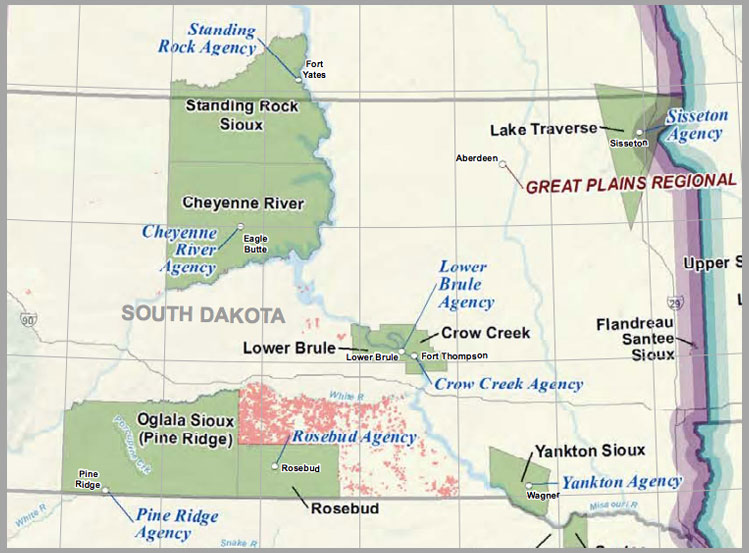
Today, South Dakota is home to nine federally recognized Native American reservations, each with its own unique history, challenges, and vibrant communities:
- Pine Ridge Indian Reservation: Home to the Oglala Lakota, it is one of the largest and most populous reservations in the U.S. and often cited for its extreme poverty, high unemployment rates, and health disparities. It was also the site of the 1973 Wounded Knee Occupation by the American Indian Movement (AIM), bringing national attention to Native American issues.
- Rosebud Indian Reservation: Home to the Sicangu Lakota (Rosebud Sioux Tribe), known for its efforts in cultural preservation and language revitalization.
- Cheyenne River Indian Reservation: Home to the Miniconjou, Itazipco, Siha Sapa, and Oohenumpa bands of the Lakota. It is the fourth largest reservation in the U.S. by area.
- Standing Rock Indian Reservation: Shared with North Dakota, home to the Hunkpapa and Sihasapa Lakota. It gained international prominence during the 2016-2017 protests against the Dakota Access Pipeline.
- Lower Brule Indian Reservation: Home to the Lower Brule Sioux Tribe (Kul Wicasa Oyate).
- Crow Creek Indian Reservation: Home to the Crow Creek Sioux Tribe (Mdewakanton, Siseton, and Yanktonai Dakota).
- Yankton Indian Reservation: Home to the Yankton Sioux Tribe (Ihanktonwan Dakota).
- Sisseton Wahpeton Oyate of the Lake Traverse Reservation: Home to the Sisseton and Wahpeton bands of Dakota.
- Flandreau Santee Sioux Reservation: Home to the Flandreau Santee Sioux Tribe (Isanti Dakota).

Life on these reservations is a complex tapestry of enduring culture and systemic challenges. Many reservations face some of the highest poverty and unemployment rates in the nation, often exceeding 50%. This is compounded by inadequate infrastructure, limited access to quality healthcare, and educational disparities. The legacy of historical trauma manifests in disproportionately high rates of substance abuse, suicide, and chronic diseases. The issue of Missing and Murdered Indigenous Women (MMIW) and girls is also a critical concern, highlighting the vulnerability and marginalization faced by Indigenous communities.
Sovereignty, Cultural Revival, and the Fight for Justice
Despite these formidable obstacles, the spirit of the Oceti Sakowin endures, vibrant and resilient. Tribal sovereignty is a cornerstone of their existence, granting tribes inherent rights of self-governance, including the ability to establish their own laws, courts, and social programs. This self-determination is crucial for addressing the unique needs of their communities and preserving their distinct identities.
Cultural revitalization is a powerful force across all reservations. Language immersion programs are working tirelessly to teach Lakota, Dakota, and Nakota to younger generations, recognizing that language is the very heart of culture and identity. Traditional ceremonies like the Sun Dance, Vision Quests, and Sweat Lodge ceremonies continue to be practiced, connecting people to their spiritual heritage. Powwows, vibrant celebrations of dance, song, and community, serve as powerful affirmations of cultural pride and continuity, drawing participants and spectators from across the nation. "Our culture is our strength," says a tribal elder. "It is what keeps us grounded, what reminds us who we are, even when the world tries to make us forget."
The fight for justice also continues. The Black Hills claim, a legal battle for the return of land illegally seized, remains unresolved. In 1980, the U.S. Supreme Court ruled that the government had illegally taken the Black Hills and awarded the Sioux Nation over $100 million in compensation. However, the tribes have consistently refused the money, demanding the return of their sacred land, not a payment for its theft. This principled stand underscores their deep spiritual connection to Paha Sapa, a bond that transcends monetary value.
Beyond land claims, contemporary activism focuses on environmental justice, protecting water resources, and addressing systemic inequalities. The protests against the Dakota Access Pipeline at Standing Rock brought Indigenous rights and environmental concerns to the forefront of national and international consciousness, demonstrating the power of unity and non-violent resistance.
Looking Forward: A Future Forged in Resilience
The narrative of Native American tribes in South Dakota is not merely a historical account; it is a living, evolving story of strength, adaptation, and an unwavering commitment to self-determination. From the devastating impact of colonial expansion and broken treaties to the ongoing struggles with poverty and systemic discrimination, the Oceti Sakowin have faced unimaginable adversity. Yet, their languages are being revived, their ceremonies continue, and their voices are growing louder in the fight for justice and sovereignty.
The challenges are immense, but so too is the resilience. The deep spiritual connection to the land, the strength of family and community bonds, and the rich cultural heritage provide a foundation for hope and continued advocacy. As the wind whispers across the prairies of South Dakota, it carries not only the echoes of past injustices but also the unwavering heartbeat of a people determined to shape their own future, preserving their traditions for generations to come, and ensuring that the enduring spirit of the Oceti Sakowin forever defines this land. "Mitakuye Oyasin," they say – "All My Relations," a powerful reminder of interconnectedness and the sacred bond between all living things, a philosophy that guides their journey forward.


